Postpartum stretch marks fade naturally from red to silver-white over 6 to 24 months. They cannot be made to disappear entirely without clinical intervention (laser or microneedling), but you can significantly speed the fading and improve the texture with a daily routine of centella asiatica, peptides, niacinamide and squalane. The window where stretch marks respond most to topical treatment is the first 12 weeks — when they are still red (striae rubra).
This is the evidence-based routine, and the realistic timeline.
Why postpartum stretch marks appear
Stretch marks (striae gravidarum during pregnancy, striae distensae after) are tears in the dermis caused by rapid stretching of the skin combined with hormonal effects on collagen and elastin. Pregnancy is a perfect storm: 9 months of progressive stretching plus elevated cortisol-like hormones that weaken connective tissue.
About 50-90% of women develop stretch marks during pregnancy. They appear most commonly on the belly, breasts, hips, and outer thighs. Genetics matter: if your mother had them, you likely will too.
Red versus white stretch marks
The colour tells you the age of the stretch mark — and how responsive it is to treatment.
Red stretch marks (striae rubra) are recent. They are inflamed; small blood vessels in the dermis are visible through the thinned skin. This is the active healing phase. Topical actives can meaningfully shift the outcome at this stage.
White or silver stretch marks (striae alba) are mature, often 12+ months old. The inflammation has resolved; what remains is a permanent area of altered collagen and atrophied dermis. Topical treatment has limited but real effect here — texture and slight pigmentation can still improve, but the lines themselves are largely permanent without microneedling or laser.
The implication: the postpartum window, especially weeks 4 to 16, is the highest-leverage time to treat.
The ingredients that actually work
Centella asiatica (cica)
The single most-studied ingredient for stretch marks. Centella (specifically the madecassoside, asiaticoside, and TECA extracts) stimulates collagen type I and III synthesis. Multiple clinical trials show reduction in stretch mark length and width when applied daily for 12+ weeks.
Peptides (Matrixyl-3000, copper peptides)
Matrixyl-3000 (palmitoyl tetrapeptide-7) signals fibroblasts to produce collagen. Copper peptides accelerate wound healing. Both are pregnancy- and breastfeeding-safe.
Niacinamide (vitamin B3)
At 4-5%, niacinamide supports the skin barrier and modulates pigmentation — useful when red stretch marks are transitioning to brown or hyperpigmented before fading to white.
Squalane
Doesn't fade stretch marks directly. It supports the surrounding skin's barrier so the active ingredients can work without irritation. Also softens the texture of mature stretch marks.
What does not work, despite the marketing
- Cocoa butter — pleasant smell, no clinical evidence beyond placebo
- Coconut oil — moisturising, no specific effect on collagen remodelling
- Vitamin E alone — limited evidence; can even irritate some skin types
- Tretinoin — effective on red stretch marks per studies but unsafe during breastfeeding
The breastfeeding-safe routine
Apply twice daily to the affected areas — most importantly when stretch marks are still red:
- After showering, while skin is still damp
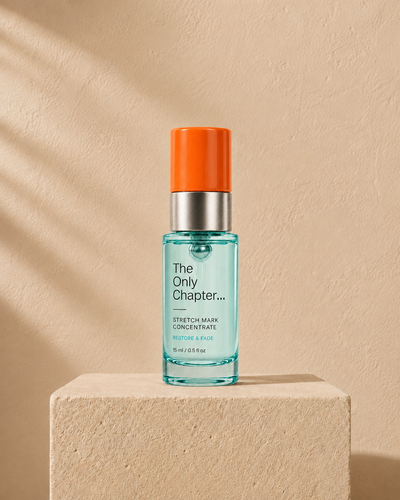
- Apply our Stretch Mark Concentrate (centella + peptides + niacinamide) to each affected area
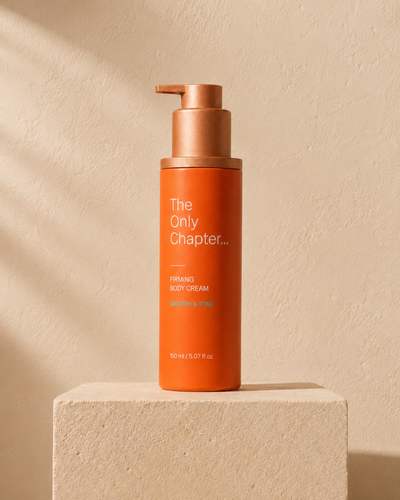
- Layer over with the postpartum body cream to seal in
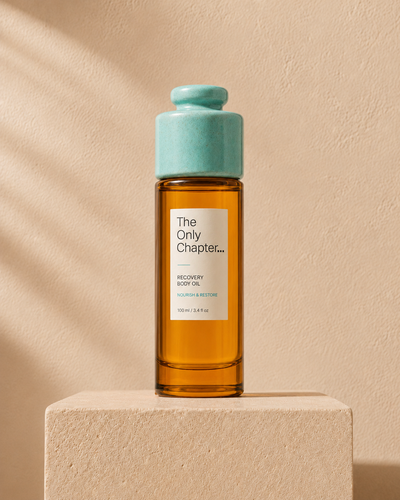
- For very dry skin or post-shower comfort, finish with a few drops of recovery body oil
Twice daily. Consistency matters more than product complexity.
The realistic timeline
Weeks 4-12: Stretch marks are red, treatment is most effective. Begin the daily routine.
Months 3-6: Red fades to pink. Marks visibly narrowing if treated consistently.
Months 6-12: Pink fades to light brown then silver. Most of the active fading happens here.
Year 2 and beyond: Marks are silver-white, mostly permanent. Texture can still improve.
When to consider clinical intervention
If after 12 to 18 months of consistent topical care the marks remain unacceptable, the evidence-based clinical options are:
- Microneedling — most effective for textural improvement
- Fractional laser (CO2 or non-ablative) — best for white, mature stretch marks
- Radiofrequency-assisted microneedling — combination, longer downtime
These are only considered once breastfeeding has ended. Cost in the UK ranges £150-£400 per session, typically 3-6 sessions needed.
FAQ on postpartum stretch marks
When is the best time to start treating postpartum stretch marks?
As soon as the skin around the marks is no longer raw or actively healing — usually 4 weeks postpartum. The earlier you start while marks are still red, the better the outcome.
Do stretch marks ever fully disappear?
Without clinical intervention, no. Topical treatment can fade them to a point where they are minimally visible on most skin tones, but the underlying altered collagen remains. With laser or microneedling, significant further improvement is possible but rarely complete erasure.
Can I prevent stretch marks during my next pregnancy?
Partial prevention is possible. Daily application of a centella + peptide cream from the first trimester onward, plus excellent skin hydration and gradual weight gain, reduces severity. Genetics still dominate, but consistency helps.
Should I use a stretch mark product if I have a c-section scar too?
Yes — the same active ingredients (centella, peptides) help both. Just respect the c-section scar timeline: nothing for the first 6 weeks, then gentle moisturising, then add actives at 12 weeks.
Is the Stretch Mark Concentrate safe while breastfeeding?
Yes. It contains centella asiatica, niacinamide, matrixyl-3000 and squalane — no retinoids, no salicylic acid above 1%, no essential oils on the chest-zone formulation.
For the full postpartum body framework, see our complete postpartum skincare guide.