No. Topical retinol is not considered safe during breastfeeding. The same precaution applies to all prescription retinoids (tretinoin, adapalene, isotretinoin) and to retinyl esters in over-the-counter formulas. There are safer, evidence-based alternatives — bakuchiol, peptides, niacinamide, centella asiatica — that deliver most of what retinol does, without the contraindication.
Why retinol is contraindicated during breastfeeding
Retinoids are forms of vitamin A. Some, like isotretinoin (oral), are known teratogens that cause severe birth defects during pregnancy. Topical retinoids are absorbed in only tiny amounts through the skin, but the body has no easy way to clear them, and they can theoretically pass into breast milk.
Available guidance from the BNF for Children, the NIH LactMed database, and most dermatology societies takes a precautionary stance: avoid all retinoids during pregnancy and during breastfeeding. The data on harm isn't catastrophic — but it isn't clean enough to recommend either.
For a body still healing — placenta gone, hormones rebalancing, ceramide barrier rebuilding — adding a known irritant with a question mark over safety isn't a trade worth making.
What about retinyl palmitate, retinaldehyde and adapalene?
All variants of vitamin A used in skincare or prescription dermatology are on the avoid list during breastfeeding.
- Retinyl palmitate — the most common OTC form. Avoid.
- Retinyl retinoate — newer ester, marketed as gentler. Same caution.
- Retinaldehyde — slightly less converted than retinol. Still avoid.
- Retinol — itself, no.
- Tretinoin (Retin-A) — prescription. Hard no.
- Adapalene (Differin) — prescription, OTC in some markets. No.
- Isotretinoin (Accutane) — oral. Absolutely contraindicated.
- Tazarotene — topical and oral. No.
Even "granactive retinoid" — a marketing label for hydroxypinacolone retinoate — sits in the retinoid class and carries the same precaution.
When can you restart retinol after breastfeeding?
Once breastfeeding has ended for at least four weeks, retinol can be reintroduced. The clearance from breast milk is short; the longer wait gives time for your skin barrier to recover and for stress hormones to normalise.
Restart slowly. Postpartum skin is more reactive than pre-pregnancy skin, even months after weaning.
- Week 1: a low percentage (0.1–0.3%), twice a week at night
- Week 2: same percentage, three times a week
- Week 3: every other night
- Week 4+: nightly if tolerated
Watch for redness, dryness or flaking. If your skin stops tolerating retinol, switch back to bakuchiol for a few weeks and try again later.
Breastfeeding-safe alternatives to retinol
Two ingredient classes deliver results that overlap with retinol without the contraindication.
Bakuchiol — extracted from Psoralea corylifolia. Acts on similar gene-expression pathways to retinol but binds differently. Peer-reviewed head-to-head studies (Dhaliwal et al., 2018) show comparable improvements in fine lines, pigmentation and texture over 12 weeks. Safe during pregnancy and breastfeeding. Tolerated at 1–2% topical concentration without irritation or photosensitivity.
Peptides — short chains of amino acids that signal collagen synthesis and barrier repair. Matrixyl 3000, copper peptides (GHK-Cu), and tetrapeptides like Acetyl Hexapeptide-8 are all breastfeeding-safe and well-tolerated.
Other supporting actives during the breastfeeding window:
- Niacinamide (up to 10%) — pigmentation, pore appearance, barrier repair
- Centella asiatica — barrier and collagen support
- Vitamin C — pigmentation and antioxidant
- Azelaic acid — pigmentation and inflammation; speak to your GP before starting prescription concentrations
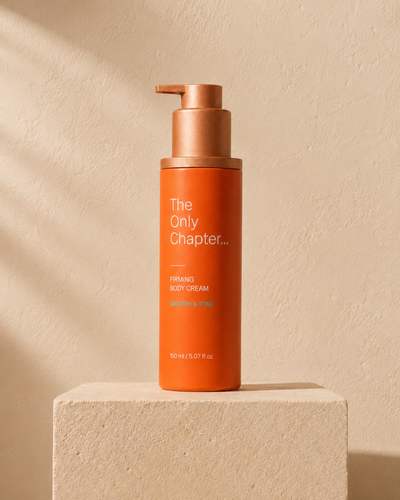
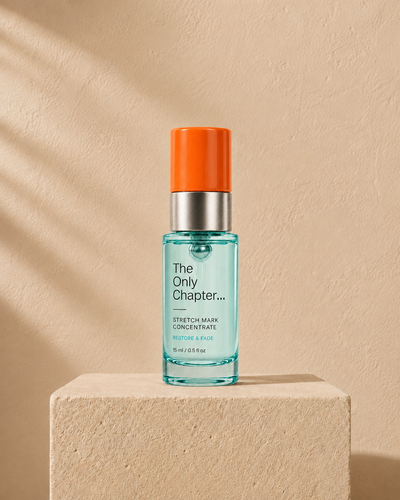
For postpartum-specific concerns — stretch marks, scarring, body firmness — the same alternatives apply. Stretch Mark Concentrate (5% niacinamide, 3% centella asiatica, bakuchiol) is formulated specifically for this window.
How to transition back to retinol postpartum
After breastfeeding ends, staging the return matters.
- Wait four weeks minimum from your last breastfeed.
- If you've been using bakuchiol, finish your current bottle first — abrupt switches confuse the skin.
- Introduce retinol on a different night from any acid (AHA, BHA). Don't layer the two.
- Use only at night. Always pair with daytime SPF 30+.
- Apply a barrier-supportive moisturiser (ceramide- and squalane-rich) on retinol nights.
Postpartum skin rebuilds at a slower rate than pre-pregnancy skin. Be patient with the introduction.
What about vitamin A in supplements while breastfeeding?
Different question. Oral vitamin A from food (dairy, eggs, leafy greens, orange vegetables) is essential and safe during breastfeeding. The maximum recommended intake from supplements is 3,000 µg/day during lactation. Avoid high-dose vitamin A supplements unless prescribed by your GP.
This article is specifically about topical retinoids in skincare, not dietary vitamin A.
FAQ on retinol during breastfeeding
How long does retinol stay in breast milk?
Topically absorbed retinol clears from the body within days, but the precautionary recommendation is to wait at least four weeks after the last breastfeed before restarting.
Can I use retinol around my eyes during breastfeeding?
No. The contraindication applies regardless of application site.
Is bakuchiol really as effective as retinol?
For fine lines and pigmentation: comparable over 12 weeks in head-to-head studies. For severe acne: retinol is more effective. For postpartum skincare: bakuchiol is the right choice.
Can I use retinol on my body but not my face while breastfeeding?
No. Topical absorption rates can be higher on the body than the face for many ingredients. The precaution applies everywhere.
What if I used retinol by accident while breastfeeding?
Don't panic. Single-use exposure is extremely unlikely to cause harm. Stop the product, speak to your midwife or GP, and continue breastfeeding as normal.
Does adapalene have a longer clearance window than retinol?
Adapalene has a longer topical half-life but isn't more systemically absorbed. The four-week post-breastfeeding wait still applies.
Can I use retinol if I'm pumping and dumping?
"Pump and dump" doesn't remove a topical agent from your bloodstream or milk efficiently. The four-week wait still applies.
In summary
Retinol — and all its retinoid relatives — is not safe during breastfeeding. The data isn't catastrophic, but it isn't clean. Bakuchiol, peptides, niacinamide and centella asiatica deliver overlapping benefits without the contraindication. After breastfeeding ends, wait four weeks before reintroducing retinol, and start slowly.
For a postpartum skincare routine built entirely around breastfeeding-safe actives, our clinical guide covers the full six-month protocol.