In the first six weeks after surgery, put nothing directly on a c-section scar — keep it clean, dry, and let your surgical team confirm full closure. From six weeks onwards, the gold standard is silicone (gel sheets or silicone-based ointment), combined with gentle massage. After three months, oils with vitamin E and rosehip support continued softening and pigmentation fade.
The first six weeks: do less, not more
A c-section is a major abdominal surgery. The skin is closed, but the layers underneath — muscle, fascia, peritoneum — are still healing. The visible scar at week one represents around 5% of the total healing process.
During this period:
- Keep the incision clean and dry. Pat after showering rather than rub.
- Wear loose, breathable clothing. Avoid waistbands that press on the incision.
- Do not apply any cream, oil or ointment directly to the unhealed scar unless your midwife, GP or surgeon has specifically advised it.
- Watch for signs of infection: increasing redness, warmth, discharge, or fever. These need urgent medical review.
The temptation to "do something" is strong, particularly if your body image is already fragile in those weeks. Resist it. Premature application of even gentle products can disrupt healing and increase scarring.
Six weeks onwards: silicone is the gold standard
Once your scar has fully closed — your six-week check is the typical moment your GP or midwife will confirm this — you can begin active scar care. The single best-evidenced intervention is silicone.
Silicone for scar care comes in two forms:
- Silicone gel sheets: adhesive strips that sit on the scar 12–23 hours a day for 8–12 weeks. Most effective form. Brands: Mepiform, Cica-Care, ScarAway.
- Silicone gel or ointment: liquid silicone applied twice daily. More practical for c-section scars under clothing. Brands: Kelo-cote, Dermatix, Stratamed.
A 2014 meta-analysis in Aesthetic Plastic Surgery found silicone to be more effective than every other topical intervention for reducing scar thickness, redness and pliability. The mechanism: silicone creates a semi-occlusive barrier that hydrates the stratum corneum, normalises collagen synthesis, and reduces keratinocyte stimulation of fibroblasts.
Apply consistently. Inconsistent use is the most common reason silicone "doesn't work" in practice.
Gentle scar massage
From the six-week mark, add a daily two-minute scar massage. The technique:
- Wash hands. Use a small amount of plain moisturiser or a fragrance-free oil as a glide medium — not the silicone itself.
- Press flat fingers along the length of the scar with gentle pressure (enough to blanch the skin slightly).
- Move in three patterns: along the length of the scar, perpendicular to it, and in small circles.
- Two minutes total. Once daily.
Scar massage helps break up the adhesions that form between scar tissue and underlying fascia. Without massage, these adhesions can cause pulling, numbness, and uneven appearance.
Stop and consult your GP if massage is acutely painful or if the scar feels hot or unusually firm.
Three months onwards: oils, peptides and pigmentation
By three months, the scar is mostly remodelled. Active care now shifts from healing to long-term softening and pigmentation correction. Useful ingredients:
- Rosehip seed oil — provides essential fatty acids and natural retinoic acid precursors. Good evidence for scar softening.
- Vitamin E (tocopherol) — antioxidant; controversial in early healing, useful from three months.
- Peptides (GHK-Cu, matrixyl) — support collagen remodelling.
- Niacinamide — addresses the brown pigmentation many c-section scars develop.
- Sodium hyaluronate — hydration support; useful in oily formats.
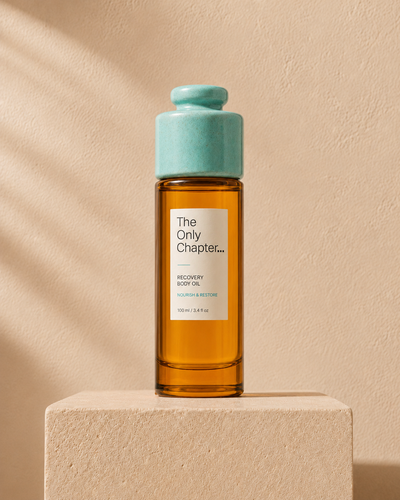
Our Recovery Body Oil contains squalane, rosehip and vitamin E in proportions designed for this phase of scar care.
Raised, ridged or itchy scars: when to seek help
Most c-section scars heal flat and fade over 12–18 months. Some develop into:
- Hypertrophic scars — raised, red, but stay within the original incision line. Often respond well to silicone + pressure.
- Keloid scars — extend beyond the original incision; more common in darker skin tones. Require specialist care: steroid injection, cryotherapy, laser.
If your scar is raised more than 2mm above the surrounding skin at three months, ask your GP for a dermatology referral.
FAQ on c-section scar care
Can I put vitamin E on a fresh c-section scar?
No — wait until at least three months. In the early phase, vitamin E can disrupt healing and increase the risk of contact dermatitis.
Is silicone safe during breastfeeding?
Yes. Topical silicone has no systemic absorption.
How long does it take for a c-section scar to flatten?
With consistent silicone use, most scars are visibly flatter at 8–12 weeks. Full remodelling continues for up to two years.
Why is my c-section scar darker than the surrounding skin?
Post-inflammatory hyperpigmentation. More common in melanin-rich skin. Niacinamide and time are the best interventions. Avoid sun exposure on the scar — UV deepens the pigmentation.
Should I use Bio-Oil on my c-section scar?
Bio-Oil is acceptable from three months onwards. It is not breastfeeding-safe due to the inclusion of fragrance; check the current formulation if you are still nursing.
Can I get rid of a c-section "shelf" (the overhang)?
The overhang above a c-section scar is mostly tissue tethering, not fat. Scar massage helps. Diet and exercise alone do not address it. Persistent significant overhangs are sometimes corrected by minor revision surgery — discussed only with a specialist.
When can I have a tummy tuck or scar revision?
Not before 12 months post-section, and not before completing your family if more children are planned.
For the broader recovery routine in the early postpartum period, see our postpartum skincare guide.