Melasma — sometimes called the "mask of pregnancy" — affects somewhere between 50 and 70 percent of pregnancies in the UK. It usually appears across the cheeks, forehead, upper lip and bridge of the nose. It is hormonal, photo-aggravated, and stubborn. And for many women, it does not simply fade after the baby arrives.
This guide explains why postpartum melasma lingers, what makes it worse without anyone telling you, and how to fade it using ingredients that are safe to use while breastfeeding.
The short answer
Pregnancy melasma is driven by oestrogen and progesterone activating melanocytes (pigment cells) in sun-exposed skin. After birth, those hormones drop — but the pigment that was already deposited does not vanish. Without sun protection and targeted topical actives, melasma typically persists for 6 to 12 months postpartum, and sometimes longer. With the right approach, most cases fade significantly within 4 to 8 months.
The single most important factor is not your skincare. It is daily mineral SPF, applied every morning, including on cloudy days and in winter. Without that, no active will outpace the re-pigmentation.
Why melasma lingers after birth
Melanocytes that were "primed" by pregnancy hormones remain hypersensitive to UV and visible light for months after delivery. Even brief sun exposure — walking the buggy to the park, sitting near a window — can re-trigger pigment production. This is why the same sun exposure that produces a light tan on the rest of your body produces deeper patches on the cheeks and upper lip.
Add three postpartum factors and you have a perfect storm: (1) sleep deprivation increases cortisol, which can worsen pigment dysregulation, (2) breastfeeding maintains some elevated prolactin and estriol, prolonging melanocyte sensitivity, (3) most new mothers reduce their skincare consistency because everything else is harder.
What is safe to use while breastfeeding
The standard dermatology answer for melasma is hydroquinone, tretinoin (retinol) and sometimes corticosteroids — often in combination. None of those is recommended during breastfeeding. The British National Formulary advises against topical retinoids during lactation and counsels caution on hydroquinone given limited safety data.
The good news: there are effective alternatives backed by clinical evidence.
Yes, safe while breastfeeding:
- Vitamin C (L-ascorbic acid 10–20 percent). Tyrosinase inhibitor, also strengthens the skin barrier. Use morning under SPF. Stable formulations only.
- Azelaic acid 10–20 percent. Excellent for postpartum melasma. Anti-inflammatory and tyrosinase-inhibiting. NHS-prescribable and safe during lactation. This is the most under-used postpartum pigmentation active in the UK.
- Niacinamide 5 percent. Reduces melanosome transfer (the pigment movement to skin surface). Well tolerated, breastfeeding safe.
- Tranexamic acid (topical 3–5 percent). Recent evidence positions it as one of the best alternatives to hydroquinone. Topical use is considered low-risk during breastfeeding. Oral is a separate conversation with your GP.
- Alpha-arbutin 2 percent. Gentler tyrosinase inhibitor, often combined with the above.
Avoid while breastfeeding:
- Retinol, retinal, retinyl palmitate, tretinoin, adapalene — see our full guide on retinol and breastfeeding for the detail.
- Hydroquinone (limited safety data — most dermatologists pause until weaning).
- Topical kojic acid at high concentrations — limited data postpartum.
- Chemical peels above superficial glycolic — not contraindicated but most clinics defer until after breastfeeding.
The protocol that actually works postpartum
A simple, breastfeeding-safe melasma routine that does not require 12 products:
- Morning — gentle cleanse → vitamin C 10–15 percent serum → moisturiser → mineral SPF 50+ with iron oxides (iron oxides also block visible light, which standard SPF does not — visible light is one of the biggest postpartum melasma triggers).
- Evening — gentle cleanse → azelaic acid 10–20 percent OR tranexamic acid 3 percent (alternate nights) → moisturiser. Niacinamide can be mixed into either morning or evening depending on what your skin tolerates.
- Weekly — low-percentage lactic or mandelic acid (5–8 percent) once or twice a week to support cell turnover gently.
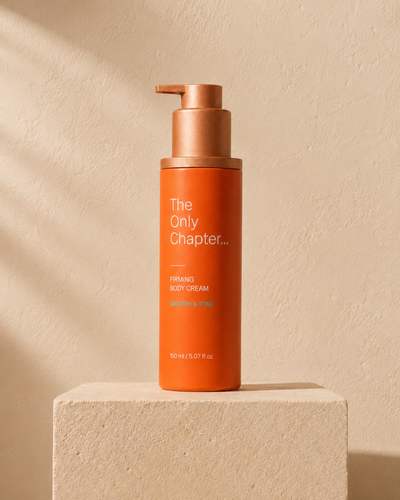
For the moisturiser layer, breastfeeding-safe means fragrance-free, no retinol/retinal, no salicylic acid above 2 percent. Our Firming Body Cream is formulated to be safe across pregnancy and breastfeeding and works on the face — it sits well under SPF and does not interfere with azelaic or vitamin C.
Sun protection is the lever
The single intervention that changes melasma outcomes is daily mineral SPF, applied generously (about 2 finger-lengths for the face), every morning, reapplied if you are outside more than 90 minutes. Iron oxides in the formulation matter — visible light penetrates clouds and windows and is one of the dominant triggers in postpartum melasma. SPF without iron oxides (most non-tinted mineral SPFs) addresses UV but not visible light.
In the UK, a wide-brimmed hat when walking the buggy in summer is more protective than any active. Boring but true.
How long until it fades
With consistent SPF and a vitamin C + azelaic acid combination, most postpartum melasma fades 50 to 70 percent within 4 to 6 months. Full clearance can take 8 to 12 months, especially for deeper dermal melasma. Some women find their melasma never fully clears between pregnancies if they have multiple, and that is normal — it can be retreated after weaning with stronger options if needed.
What does not happen, despite the popular belief: melasma does not simply "go away on its own" after birth in most women. It needs the combination of sun protection and targeted actives.
FAQ
Does pregnancy melasma always fade after birth?
About 30 percent of women see significant fading in the first 3 months postpartum. The remaining 70 percent need active intervention — sun protection plus topical actives — for clear fading.
What is the best ingredient for postpartum melasma if I'm breastfeeding?
Azelaic acid 10–20 percent and topical tranexamic acid are the two best-evidenced options that are also breastfeeding safe. Vitamin C as a daily morning anchor.
Can I use vitamin C while breastfeeding?
Yes — topical vitamin C (L-ascorbic acid) is considered safe during breastfeeding. Use a stable formulation in the morning under SPF.
Will my melasma get worse if I have another baby?
It can — pregnancy hormones reactivate it. Most dermatologists recommend treating postpartum melasma fully before a next pregnancy, and continuing daily SPF through both.
Why doesn't SPF alone fade my melasma?
SPF prevents new pigment forming. It does not break down existing pigment. You need an active (azelaic, vitamin C, tranexamic acid) to encourage existing pigment to fade. Without SPF the actives are losing a race.