Start massaging your c-section scar at six weeks postpartum, once your GP or midwife has confirmed the incision is fully closed at the standard postnatal check. Massage twice a day for two minutes per session, using a fragrance-free moisturiser as glide medium. The pattern: along the scar, perpendicular to it, then in small circles. Continue daily for at least 12 weeks for the best outcome.
Why scar massage matters
The visible line on the abdomen at week six is only the surface of a c-section. Underneath: layers of fascia, muscle and peritoneum that healed in their own way, often with internal adhesions — strands of scar tissue that bind layers together that shouldn't be bound.
These adhesions are the cause of the "pulling" sensation, numbness, uneven appearance and (in some cases) chronic pelvic pain that women report at three months and beyond. Daily scar massage from week six dramatically reduces all of those.
The research base: a 2018 systematic review in Annals of Plastic Surgery found scar massage starting at the appropriate post-surgical window improved scar pliability, reduced raised scarring, and softened texture more than passive care alone.
Why not before six weeks
The incision needs time to close fully. The visible suture line at week one represents about 5% of the total healing. The internal layers — fascia, muscle, peritoneum — are still in active repair through weeks two to four. Pressure on the scar in this window risks:
- Disrupting the closure and reopening (dehiscence) — rare but serious.
- Introducing infection through micro-pressure.
- Disrupting collagen alignment as the tissue remodels.
Wait until the six-week postnatal check. If your GP or midwife confirms full closure, you can start the next day. If they note any residual concern — incomplete closure, a small open area, signs of dehiscence — wait until they clear it.
The technique, step by step
- Wash your hands. Always.
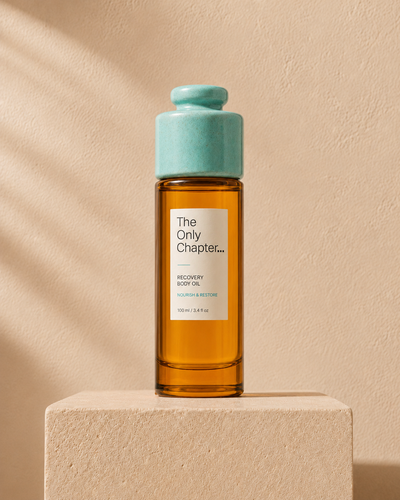
- Apply a small amount of fragrance-free moisturiser or oil as a glide medium. We use Recovery Body Oil for this — squalane and rosehip support the surrounding skin and don't sting on still-tender skin.
- Place two or three flat fingers on the scar with gentle, even pressure — enough to blanch the skin slightly. Not a heavy push.
-
Move in three patterns, each for 30 seconds:
- Along the length of the scar (left to right and back).
- Perpendicular to the scar (up and down across the line).
- Small circular motions, working from one end to the other.
- Two minutes total. Once or twice daily.
The whole technique takes longer to describe than to do.
How firmly to press
The pressure should be:
- Enough to slightly blanch (whiten) the skin under your fingers.
- Not enough to cause sharp pain — discomfort is normal in early sessions, sharp pain is not.
- Adjustable — start lighter for the first week of massage, build pressure gradually.
If the area feels hot, unusually firm or like a hard lump under the skin, stop and consult your GP. A small minority of c-section scars develop seromas (fluid collections), hematomas or wound infections that present this way and need medical assessment, not massage.
How long to keep doing it
Daily for at least 12 weeks from when you start. Many practitioners recommend continuing daily for 6 months, then a few times a week through the first year. The remodelling of scar tissue continues for up to 24 months postpartum; massage in the first year captures the most active part of that window.
Combining massage with silicone scar care
Massage and silicone are the two evidence-based interventions for c-section scar care, and they complement rather than compete:
- Apply silicone gel or sheet first (early in the day or overnight).
- Do the massage at a separate time, using a different glide medium — moisturiser or oil, not the silicone itself.
The technique for silicone is covered in our c-section skincare guide.
What if scar massage hurts more than it should?
Sharp pain, persistent burning, or numbness that worsens during massage are signs to stop and seek help. Possible causes:
- Adhesions involving nerves — a specialist scar-tissue physiotherapist or pelvic-health physio can release these manually.
- Endometriosis embedded in the scar — rare but documented. Cyclical pain with menstruation is the clue.
- Hypertrophic or keloid development — visible thickening that pain accompanies.
Don't push through pain. A 30-minute physio assessment is far more useful than two more weeks of unhappy self-massage.
Pelvic-health physiotherapy: when to consider it
In the UK, postpartum pelvic-health physiotherapy is sometimes available on the NHS and widely available privately (£60–£100 per session). For c-section recovery specifically, a physio with scar-tissue training can:
- Assess adhesions internally and externally.
- Release tethered scar tissue manually.
- Teach you a more advanced massage technique tailored to your scar.
- Identify pelvic-floor co-issues that often coexist.
One or two physio sessions in the first three months postpartum often add disproportionate value to your recovery.
FAQ on c-section scar massage
How soon after a c-section can I start massaging the scar?
Six weeks postpartum, after your postnatal check confirms full closure. Not before.
Can I do scar massage if I had staples or stitches?
Yes — once removed and the area has closed. Glue, dissolvable sutures, staples and clips all heal to a similar timeline. The closure is what matters, not the original method.
What if my c-section scar still hurts at six weeks?
Some tenderness is normal. Significant pain is not. See your GP if the area is hot, swollen, oozing, or hurts more than it did the previous week.
Can I massage if I plan to have another c-section?
Yes. Scar massage between pregnancies improves the tissue baseline and can mean a better second-surgery healing.
How much oil or cream should I use?
A small amount — about a pea-sized drop of oil or half a teaspoon of cream — is enough for the whole scar. Excess just makes the surface slippery without helping the massage.
Does scar massage flatten a raised scar?
Combined with silicone, yes — it noticeably reduces hypertrophic raising over 8–12 weeks. Keloid scarring (extending beyond the original incision line) needs specialist treatment.
Can I do scar massage during pregnancy if I have a prior c-section?
Gentle massage with a moisturiser is fine through pregnancy and supports overall tissue health. Avoid deep pressure.
What's the difference between scar massage and lymphatic drainage?
Scar massage targets the scar tissue and adhesions directly. Lymphatic drainage is a broader, lighter technique that supports overall fluid clearance. Both can complement c-section recovery; they are not the same intervention.
For the broader c-section recovery framework, see our c-section skincare guide. For the day-by-day product protocol, read what to put on a c-section scar.