The linea nigra is the vertical brown line that appears down the centre of the belly during pregnancy, running from the pubic bone up toward the navel — sometimes further. It is one of the most universal pregnancy skin changes, and one of the most common postpartum questions: when will it fade?
This is a short, honest guide. There is almost nothing alarming to know — but there are a few things that genuinely speed the fading process, and a few things that slow it down.
What it is
Everyone has a midline of slightly different-coloured tissue down the belly — it is called the linea alba in its normal pale state. During pregnancy, rising oestrogen and melanocyte-stimulating hormone darken the melanocytes along that line, turning it from invisible to a noticeable brown stripe. The line is harmless. It is not a sign of any underlying condition. About 75 percent of pregnant women develop a visible linea nigra by the third trimester, with darker skin tones often showing it earlier and more prominently.
It is the same hormonal mechanism that causes postpartum melasma on the face and the darkening of the areolas. All three of these are physiological pregnancy hyperpigmentation, and all three fade on a similar timeline.
When it fades
Most linea nigras start fading within 2 to 3 months after birth, as pregnancy hormones decline. The pigment is usually gone — or almost gone — by month 12. The timeline tends to run longer if:
- You are breastfeeding (some hormones remain mildly elevated)
- You have a deeper skin tone (more melanin to clear)
- The skin over the belly gets sun exposure (which reactivates the melanocytes)
For some women — particularly with Mediterranean, Middle Eastern, South Asian or African skin tones — the linea nigra may persist as a faint shadow for years. This is not a treatment failure. It is the natural endpoint of how that particular skin responds to the hormonal event.
What slows the fading
One factor matters more than all the others: sun exposure on the belly. The melanocytes along the linea nigra remain hyper-reactive to UV for months after birth. A few hours of direct sun on the bare belly — common in the postpartum summer — can refresh the line and reset the fading clock.
If you spend time outside with your stomach exposed (beach, garden, holiday), wear a light cover or apply mineral SPF 50 specifically along the midline. This single habit makes more difference than any cream.
What gently helps
You do not need to "treat" the linea nigra. It will fade on its own. But if you want to gently support the process — especially if it is being slow to clear — three things help:
1. Daily moisturiser with mild active ingredients
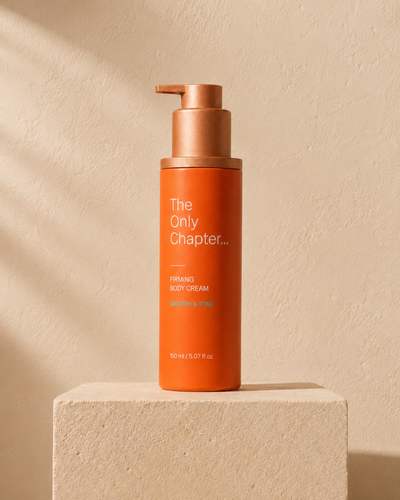
A body cream with niacinamide, squalane and gentle peptides supports the skin barrier and quietly aids cell turnover along the midline. The same product you use on your whole belly works. The Firming Body Cream is built around exactly this profile — squalane, peptide complex, pregnancy and breastfeeding safe, fragrance-free.
2. A few weekly minutes with a gentle exfoliant
A mild lactic or mandelic acid lotion (5 to 8 percent), used on the belly once or twice a week in the evening, helps the surface pigment shed faster. Use it only after the umbilical area has fully healed (around week 4 to 6 postpartum). Avoid stronger acids while breastfeeding.
3. Time, and sun protection
The bulk of the fade happens between months 3 and 8. Mineral SPF on the belly during summer afternoons is more impactful than any active.
When to mention it to a GP
You can safely ignore the linea nigra. The only reasons to mention it to a GP are:
- It becomes itchy, raised, scaly or painful (which suggests a different skin condition, not normal pigmentation)
- It dramatically darkens months after delivery rather than fading (very rare — sometimes associated with adrenal or thyroid issues worth checking)
- You are 18 months postpartum and the line has not visibly faded at all — worth confirming nothing else is going on
The brand take
The linea nigra is part of the visible record your body keeps of a pregnancy. It tells you nothing about what your stomach will look like long-term, nothing about your fitness, nothing about how you should feel. It is pigment. It fades.
If you want to do something kind for the belly skin while the line is doing its slow disappearing act — that is also where the stretch marks are, where the c-section line might be, where the skin feels thinnest — apply a barrier-repair cream every morning and evening for the first six months. The line will fade either way. The skin underneath will be in a much better state if you treated it gently through the recovery.
FAQ
How long does linea nigra take to fade?
Most fade significantly within 3 to 6 months postpartum and are gone (or nearly gone) by 12 months. Deeper skin tones may take longer.
Is it permanent?
Almost never. About 5 to 10 percent of women retain a faint shadow long-term, especially with deeper skin tones — but a clearly visible dark line is temporary.
What makes the linea nigra darker after birth?
Sun exposure on the bare belly is the main factor. Even brief sun makes the melanocytes along the line re-pigment. SPF on the belly in summer is more important than any cream.
Can I use retinol on my linea nigra while breastfeeding?
No — retinol is not recommended during breastfeeding. Azelaic acid is the breastfeeding-safe alternative if you want to actively fade it. See our full guide on retinol and breastfeeding.
Will my next pregnancy bring it back?
Almost certainly yes, and usually darker than the first time. The melanocytes along that line remember the previous hormonal trigger.