Postpartum stretch marks fade through two distinct phases: red (striae rubra) to silver (striae alba). The colour shift typically completes between 6 and 18 months after birth, with most of the visible improvement happening between months 3 and 12. The texture — a faint indentation or ridge — softens but rarely disappears entirely without clinical intervention.
The natural fade timeline
Stretch marks are tears in the dermis. The body's repair pattern — fibrous scar tissue different in texture from surrounding skin — passes through predictable colour phases as it remodels:
- Weeks 0 to 4 — fresh marks are red, purple or pink. Inflammation and engaged microvasculature give them their colour.
- Months 1 to 3 — colour deepens slightly. This is striae rubra at its peak.
- Months 3 to 6 — the most active transition. Red fades to pink, then to brown or copper on some skin tones.
- Months 6 to 12 — most marks turn pale. The visible "scar" softens.
- Months 12 to 24 — the final fade to silver-white (striae alba). After this, the colour is largely stable.
By the two-year mark, most postpartum stretch marks have reached their final colour. They will not continue to fade meaningfully without additional intervention.
What determines how fast they fade
Five factors influence the timeline:
- Genetics — by far the strongest factor. Some women fade in 6 months; others take 18+.
- Skin tone — melanin-rich skin often passes through a brown/copper phase before reaching silver, which can take longer overall.
- Severity of original stretching — twins, large babies or rapid weight changes typically leave deeper marks that fade slower.
- Topical care in the first 12 weeks — the responsive window. Peptides, centella, niacinamide applied daily can accelerate the visible improvement.
- Sun exposure — UV slows fading and can deepen pigmentation in the brown phase. Cover or sunscreen the marks during that period.
The first 12 weeks: the responsive window
The red phase is when stretch marks respond most to topical treatment. The dermis is still in active remodelling mode; local microvasculature is engaged; fibroblasts are at their most receptive to ingredients that signal collagen and elastin synthesis.
The protocol that has the best evidence:
- Centella asiatica (cica) at 2–5% — twice daily.
- Peptide complexes (matrixyl, GHK-Cu) — daily on the marks.
- Niacinamide at 4–5% — daily.
- Squalane — to support the surrounding skin's barrier.
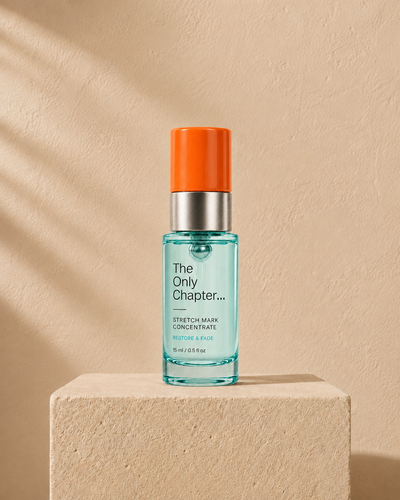
Our Stretch Mark Concentrate is formulated for this exact window. For the full routine, see how to fade postpartum stretch marks.
What can speed the fade
Daily topical work
Consistency matters more than product complexity. Twice-daily application of an active concentrate for 12 weeks reliably accelerates the red-to-pink transition. Take photos in the same light every 4 weeks; the progression is rarely dramatic week to week but is usually clear at 12 weeks.
Hydration and barrier care
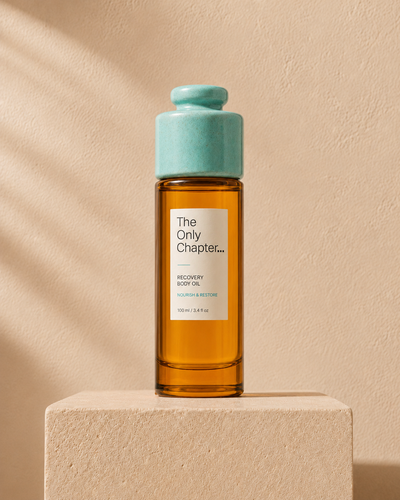
Stretch marks fade faster on well-hydrated, elastic skin. The daily body cream + oil routine described in our postpartum skincare routine provides the environment in which the active ingredients work.
Massage
Two minutes per region, daily, with a body oil or cream as glide medium. Massage breaks up adhesions and improves local microcirculation. The same technique used for c-section scars (see when to start massaging c-section scar) applies.
UV protection in the brown phase
If your stretch marks pass through a brown or copper phase before silver — common on melanin-rich skin — keep them out of direct sun. UV exposure deepens the pigmentation and slows the transition.
What does NOT accelerate the fade (despite the marketing)
- Cocoa butter — pleasant moisturiser, no evidence for stretch-mark fade beyond placebo.
- Coconut oil — moisturising only.
- Vitamin E alone — limited evidence; can irritate some skin.
- "Stretch mark removal" creams promising fast results — generally over-promised. The biology takes the time it takes.
- Tretinoin / retinol — effective per studies but unsafe during breastfeeding.
When the natural fade stalls: clinical options
If after 12 months of consistent topical care the marks are still bothering you, and you have stopped breastfeeding, the evidence-based clinical options are:
- Microneedling — induces controlled injury to stimulate collagen. Strong evidence, particularly for striae rubra (fresh marks). 3–6 sessions, £150–£300 each in the UK.
- Fractional laser (CO2 or non-ablative) — best for white, mature stretch marks. 4–8 sessions, £250–£500 each.
- Radiofrequency microneedling — combination treatment, longer downtime, stronger results.
- Topical tretinoin 0.1% — for striae alba, only after weaning. Slow but effective.
Discuss with a dermatologist or aesthetic doctor who has specifically treated postpartum stretch marks.
FAQ on when stretch marks fade
How long until red stretch marks turn white?
6 to 18 months for most women. The exact pace depends on genetics, skin tone, original severity, topical care and sun exposure.
Will my stretch marks ever fully disappear?
The colour fades dramatically — most marks become a faint silver line that is hard to see in normal light. The texture (subtle ridge or indentation) is structural and rarely fully resolves without microneedling or laser.
Is it too late to treat my stretch marks if they're already white?
Not too late, but expect slower progress. Peptides, niacinamide and consistent moisture still improve appearance over 6+ months. Microneedling and laser are the faster routes if you have weaned.
Do men get stretch marks? Do they fade differently?
Yes — from rapid muscle gain, weight changes or growth spurts. The biology and timeline are similar. Postpartum-specific factors (lactation, hormonal cliff) don't apply.
Why do mine look worse than my sister's after the same kind of pregnancy?
Genetics. Up to 60% of the variation in postpartum stretch mark severity is genetic. The factors you can control (hydration, care, weight management) are the remaining 40%.
Should I worry if my stretch marks are itchy?
Itching is common during the red phase and usually settles with regular moisturising. Persistent itching, redness or rash should be assessed by a GP — postpartum eczema and PUPPS (pruritic urticarial papules and plaques of pregnancy) can present similarly.
Can my second pregnancy give me new stretch marks even if my first didn't?
Yes. The body grows differently each time. Some women develop new marks; others find existing marks deepen rather than new ones forming.
Are postpartum stretch marks ever a sign of something medical?
Rarely. Pregnancy stretch marks are mechanical. If they are unusually purple, very widespread without obvious cause, or accompanied by other symptoms (weakness, easy bruising), mention them at your six-week check.
For the full clinical routine, see our postpartum skincare guide.